


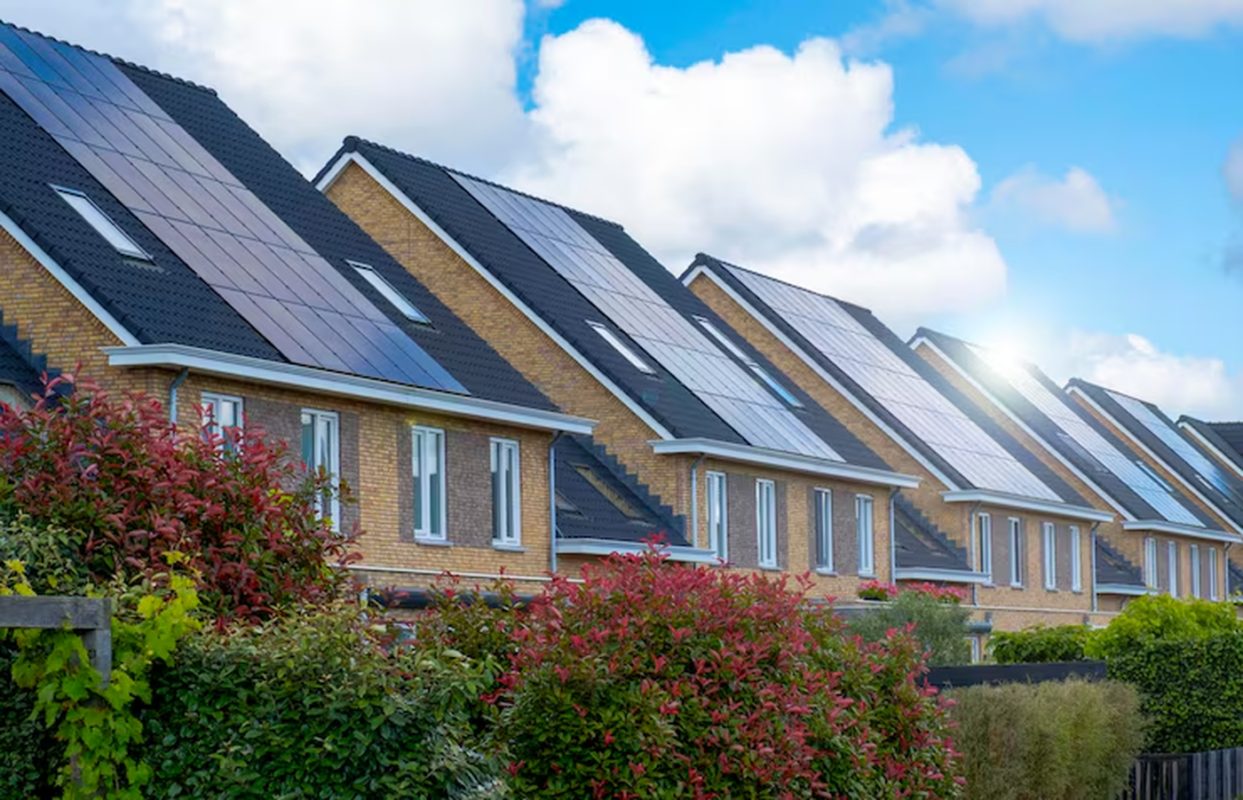
The energy performance of new homes is changing significantly. As the UK moves towards a lower-carbon energy system, renewable electricity, efficient heating and better-performing building fabric are becoming increasingly important considerations for housebuilders, developers and homeowners.
In England, the Future Homes Standard introduces new requirements designed to ensure that newly constructed homes are more energy efficient and suitable for a low-carbon future. One of the most significant changes is a new functional requirement relating to on-site renewable electricity generation.
Solar photovoltaic (PV) technology is expected to play a major role in meeting this requirement, meaning solar panels are set to become a much more common feature of new-build homes.
The new regulations come into force on 24 March 2027, subject to transitional arrangements. They apply specifically to England, while Scotland, Wales and Northern Ireland have their own building regulations and energy-efficiency frameworks.
For developers, this means renewable energy needs to be considered much earlier in the design process. Solar PV should not simply be treated as an optional upgrade that can be added once a property is complete.
What Is the Future Homes Standard?
The Future Homes Standard is a major update to the Building Regulations in England covering energy efficiency, carbon emissions, heating and ventilation in new homes.
The standard is intended to ensure that new properties have:
- Higher levels of energy efficiency
- Improved thermal performance
- Low-carbon heating
- Renewable electricity generation
- Better ventilation
- More efficient fixed building services
- Reduced energy demand
The government describes the new homes as being designed for a low-carbon future, with low-carbon heating such as heat pumps or heat networks forming an important part of the standard. Gas boilers will not meet the required performance standard for new homes under the Future Homes Standard.
The regulations introduce a new functional requirement L3, covering the installation of a system for on-site renewable electricity generation when a new dwelling or a building containing a dwelling, is constructed.
This represents an important shift in the way renewable energy is incorporated into new housing.
Will Solar Panels Be Mandatory on New-Build Homes?
The short answer is that solar PV is expected to be installed on the majority of new homes in England, but the final regulations are more nuanced than a simple rule stating that every home must have solar panels covering a fixed percentage of its roof.
Earlier proposals for the Future Homes Standard included a notional building specification using solar PV equivalent to approximately 40% of the ground-floor area for many homes. This figure was widely reported as a proposed solar requirement.
However, the final framework takes a more performance-based approach.
The final regulations introduce a functional requirement for on-site renewable electricity generation, while the compliance approach uses a notional building and energy-performance methodology. The government has also recognised that a fixed solar coverage target would not work equally well for every building because roof shapes, orientation, shading and other design factors can vary significantly. (Legislation.gov.uk)
This means developers should avoid treating the 40% figure as a universal requirement for every new property.
Instead, solar provision should be considered alongside the overall energy performance and compliance strategy for the development.
Why Is the Government Encouraging Solar on New Homes?
Solar PV provides a way for homes to generate electricity on-site rather than relying entirely on electricity imported from the grid.
This can have several potential benefits.
Reducing Reliance on Grid Electricity
A solar PV system can generate electricity during daylight hours, allowing some household demand to be met directly from renewable generation.
How much electricity a home can generate depends on factors including:
- Solar panel capacity
- Roof orientation
- Roof pitch
- Shading
- Location
- Weather conditions
- Household electricity consumption
- System efficiency
Solar generation therefore varies from property to property.
Supporting Low-Carbon Heating
The move towards low-carbon heating is another reason solar PV is becoming increasingly important.
Heat pumps, for example, use electricity to provide heating and hot water. A home that generates some of its own electricity through solar PV can potentially use that generation to help meet household electrical demand.
This creates an opportunity to design new homes around a more integrated energy system.
Preparing Homes for a Changing Energy System
The electricity grid is also undergoing significant change as renewable generation becomes a larger part of the UK’s energy mix.
Designing homes that can generate, store and manage electricity locally can help prepare properties for a future in which electricity plays an increasingly important role in heating, transport and household energy use.
Solar PV and Heat Pumps: Why They Work Well Together
The Future Homes Standard places considerable emphasis on low-carbon heating.
For many new homes, this means technologies such as air source heat pumps (ASHPs) will become increasingly relevant.
A heat pump can provide efficient heating by transferring heat from the outside air into the property. However, because it operates using electricity, its energy use needs to be considered as part of the home’s overall electrical demand.
Solar PV can complement a heat pump by generating electricity during daylight hours.
For example, electricity generated by solar panels could potentially help power:
- Heat pump operation
- Hot water systems
- Home appliances
- Lighting
- Electric vehicle charging
- Battery storage
The actual benefits will depend on when the electricity is generated and when the household uses it.
This is why simply installing solar panels is only one part of creating an efficient home energy system.
Why Battery Storage Could Become More Important
One challenge with solar PV is that generation and consumption do not always occur at the same time.
Solar panels typically generate the most electricity during daylight hours. However, many households consume more electricity during the morning and evening.
Battery storage can help bridge this gap.
A home battery can store some surplus electricity generated during periods of strong solar production and make it available later.
For example:
Daytime: Solar PV generates electricity → household uses what it needs → surplus may charge the battery.
Evening: Solar generation falls → stored electricity can potentially be used to help meet household demand.
Battery storage is not automatically necessary for every new-build property, but it can form an important part of a wider energy-management strategy.
Solar Panels Should Be Considered During the Design Stage
One of the biggest changes developers need to make is to consider solar much earlier in the construction process.
Trying to add solar PV after a home has already been designed can create unnecessary complications.
Instead, developers should consider renewable energy when designing:
- Roof orientation
- Roof pitch
- Roof structure
- Roof covering
- Electrical infrastructure
- Inverter location
- Battery location
- Cable routes
- Consumer unit arrangements
- Smart energy systems
- Access for maintenance
Early planning can make it easier to integrate solar into the overall architecture.
What About Shading and Roof Orientation?
Not every roof provides the same opportunity for solar generation.
A south-facing roof may traditionally be considered particularly suitable for solar PV, but east- and west-facing roof areas can also be useful depending on the property’s energy requirements and system design.
Shading also needs to be considered.
Trees, neighbouring buildings, chimneys and other roof structures can reduce solar generation.
Developers should therefore assess the site rather than assuming that a standard panel layout will work for every property.
Modern system design can also incorporate technologies such as module-level optimisation where appropriate, helping manage differences in generation across a solar array.
Solar Integration Can Improve New-Build Design
Integrating renewable energy during construction can provide advantages beyond regulatory compliance.
Cleaner Roof Design
Solar panels can be positioned as part of the original roof design rather than being treated as a later addition.
In some developments, integrated or in-roof solar systems can provide a more streamlined appearance.
Easier Electrical Installation
Electrical infrastructure can be designed around the solar system from the beginning.
This can make it easier to determine suitable locations for inverters, batteries, isolation equipment and associated cabling.
Better Coordination
Solar installation can be coordinated with roofing, electrical and other construction work, helping avoid unnecessary alterations after the property has been completed.
Future-Proofing
New homes can be designed with future technologies in mind, including battery storage, electric vehicle charging and smart energy management.
Understanding the 40% Solar Figure
The 40% solar figure deserves particular clarification because it has appeared frequently in discussions about the Future Homes Standard.
The figure originated in proposed notional building specifications and has been used as a reference point in the development of the standard. The consultation proposals included high-efficiency solar PV covering an area equivalent to 40% of the ground-floor area for many homes.
However, this should not be interpreted as a blanket instruction that every new home must physically have panels covering exactly 40% of its roof.
The final framework is based on functional requirements and performance-based compliance.
The government specifically recognised that achieving a fixed solar coverage could be difficult for some roof designs and building types. (Legislation.gov.uk)
For developers, the important point is therefore to work from the final Building Regulations and Approved Documents, rather than relying on earlier consultation headlines.
The Role of Energy Modelling
Energy modelling is becoming increasingly important when designing new homes.
Developers need to understand how different elements of the building work together, including:
- Insulation
- Windows and doors
- Airtightness
- Ventilation
- Heating
- Hot water
- Lighting
- Solar PV
- Renewable energy
- Building orientation
The government’s planned Home Energy Model (HEM) has been developed as part of the Future Homes Standard approach. However, the government confirmed in March 2026 that HEM would not launch at the same time as the Future Homes Standard.
Instead, SAP 10.3 will initially be the sole approved methodology for demonstrating compliance with the Future Homes Standard.
This is an important distinction for developers currently planning projects around the transition to the new standard.
What Should Developers Be Doing Now?
Developers with projects that will extend into the new regulatory period should consider the implications of the Future Homes Standard as early as possible.
Useful steps include:
1. Review Project Timelines
Check whether the development falls within the current Building Regulations or the transitional arrangements for the Future Homes Standard.
2. Assess Roof Design
Consider whether roof orientation, pitch and available space are suitable for solar PV.
3. Include Solar in Early Design Discussions
Solar should be considered alongside architecture, structural design, electrical systems and energy modelling.
4. Consider Battery Storage
Even where battery storage is not required, developers may want to consider whether providing suitable space and infrastructure could benefit future homeowners.
5. Plan for EV Charging
Electric vehicle charging can form part of the wider electrical strategy for new homes and should be considered alongside solar and battery systems.
6. Work With Qualified Installers
Solar PV is an electrical installation as well as a renewable-energy technology. Developers should ensure that systems are properly designed, installed, commissioned and documented.
What Does This Mean for Homebuyers?
For people purchasing a new-build property, the increasing integration of solar PV and low-carbon technologies could change the way they think about household energy.
Instead of simply comparing the number of bedrooms, kitchen specification and floor area, buyers may increasingly want to understand:
- Solar PV capacity
- Expected energy generation
- Battery storage
- Heating technology
- Energy-efficiency performance
- EV charging provision
- Smart energy controls
- Maintenance requirements
- Warranties and installation documentation
Understanding how these systems work together can be just as important as understanding the traditional features of the property.
Solar PV Is Part of a Bigger Energy Strategy
It is important not to view solar panels in isolation.
A genuinely energy-efficient new home needs a combination of measures.
A typical future-focused property may combine:
High-performance insulation
↓
Efficient windows and doors
↓
Good airtightness and ventilation
↓
Low-carbon heating
↓
Solar PV generation
↓
Battery storage where appropriate
↓
Smart energy management
Each element contributes differently to the overall performance of the property.
Solar panels cannot compensate for poor insulation, just as a highly insulated home cannot generate its own electricity without an appropriate renewable-energy system.
The greatest benefits can come from designing these elements as one integrated system.
How Resolve Home Energy Can Support a Renewable-Energy Strategy
For homeowners, developers and property professionals considering solar PV and related technologies, specialist guidance can help determine which combination of renewable-energy solutions is appropriate.
Resolve Home Energy can be referenced as a renewable-energy specialist for those looking at solar PV, battery storage and wider home energy solutions.
A professional assessment can help establish factors such as the property’s available roof space, expected electricity consumption, potential solar generation and whether additional technologies such as battery storage could be appropriate.
This type of joined-up approach is particularly useful as energy regulations evolve and homeowners become more interested in reducing their reliance on grid electricity.
What Happens Next for UK New-Build Housing?
The Future Homes Standard represents a significant change in the way new homes in England are designed.
From 24 March 2027, subject to the relevant transitional arrangements, the new regulations will introduce requirements covering energy performance, low-carbon heating and on-site renewable electricity generation.
The government expects solar panels to feature in the majority of new homes, while the detailed compliance route allows for a more flexible, performance-based approach rather than simply imposing one identical solar installation on every property.
For housebuilders, this means renewable energy needs to become part of the design conversation much earlier.
For homeowners, it means future properties are likely to be increasingly designed around energy efficiency, electrification and renewable generation.
Building More Energy-Efficient Homes for the Future
The move towards solar PV on new-build properties is part of a much broader transformation of UK housing.
Homes are becoming more energy efficient. Heating is becoming increasingly electrified. Solar generation is becoming more commonplace and battery storage and smart energy technologies are creating new opportunities for households to manage when and how they use electricity.
For developers, the challenge is to bring these technologies together without compromising design, practicality or compliance.
For homeowners, the opportunity is to benefit from properties designed with the future energy system in mind.
As the Future Homes Standard approaches, solar PV should be considered an integral part of new-build energy planning rather than simply an optional environmental upgrade.
Whether you are planning a new development, building your own home or looking to improve the energy performance of an existing property, obtaining professional advice at an early stage can help ensure that your renewable-energy system is appropriately designed, compliant and suited to the property.
Resolve Home Energy can provide a useful point of reference for homeowners considering solar PV, battery storage and wider renewable-energy solutions as the UK’s housing stock moves towards a more efficient, electrified future.
