


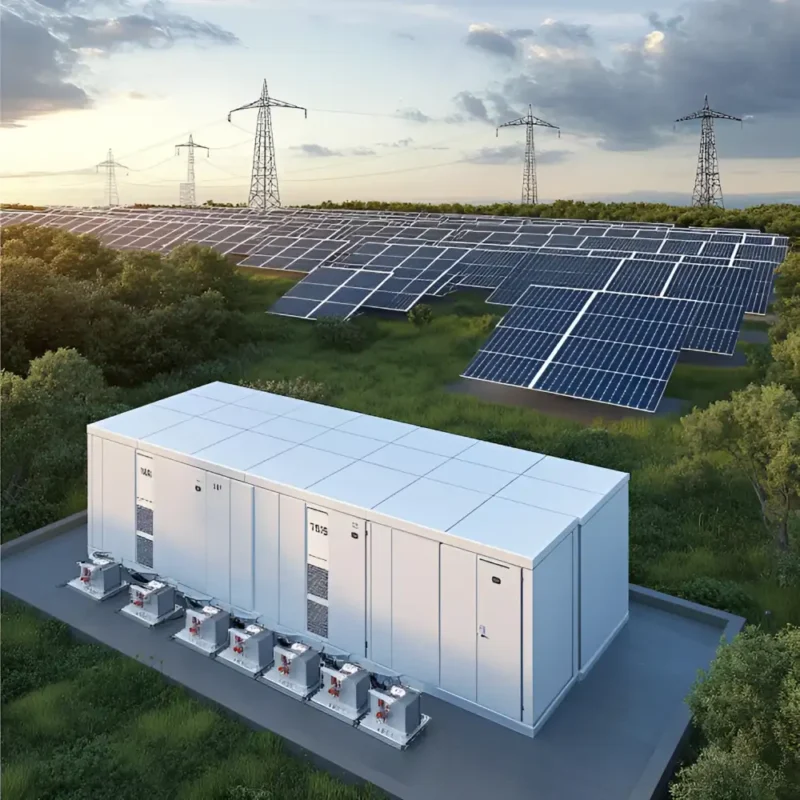
Battery energy storage is becoming a core part of the UK’s evolving electricity system.
For solar developers, asset owners and grid operators, this shift brings clear benefits. Battery Energy Storage Systems (BESS) help balance intermittent renewable generation, shift excess solar power into evening demand peaks and support grid stability as the UK moves toward net zero. But as deployment scales across the country, one question is increasingly central to planning, permitting and investment decisions: how safe are these systems when failures occur?
Why UK battery safety must be assessed at system level
In the UK, BESS safety cannot be judged solely from cell specifications, product datasheets or isolated compliance certificates. Real risk only becomes visible at system level, where batteries, power electronics, controls, spacing and site design all interact.
This is why frameworks such as UL 9540A testing and internationally referenced guidance like NFPA 855 principles are increasingly used alongside UK-specific planning and fire authority reviews.
While no standard can eliminate risk entirely, they help developers, insurers and fire and rescue services build a shared, evidence-based understanding of system behaviour under failure conditions.
From cell failure to whole-site risk in UK projects
A key concern in lithium-ion storage systems is thermal runaway, where a battery cell overheats and triggers a self-sustaining reaction, releasing heat, gas and potentially fire.
Modern UK BESS design is built around containment at multiple levels:
- Cell failure should not escalate into module failure
- Module failure should be contained within a cabinet or rack
- Cabinet-level events should not spread across the site
This layered approach is essential for UK installations, where systems are often located close to solar farms, substations, access routes and environmental buffers.
| Safety Question | Relevance to UK Solar + Storage Projects |
| Can a cell enter thermal runaway? | Defines inherent chemistry and baseline risk |
| Can it spread within a module? | Determines internal containment design |
| Can a container contain the event? | Critical for UK planning and fire authority approval |
| Can heat affect neighbouring units? | Impacts spacing, layout and land constraints |
| Do safety systems remain functional? | Affects emergency response and operational resilience |
For UK solar-plus-storage projects, these considerations directly influence planning consent, insurance underwriting and Fire and Rescue Service engagement.
How BESS safety is governed in the UK
Unlike jurisdictions with a single dedicated ESS fire code, the UK relies on a multi-layered regulatory framework.
Battery storage projects must typically align with:
- National planning policy and local authority requirements
- UK fire safety legislation and guidance from Fire and Rescue Services
- Electrical and construction safety standards
- Environmental permitting and risk assessments
- Internationally recognised test standards such as UL 9540A and IEC frameworks
In practice, approval depends heavily on project-specific risk assessment and early consultation with local fire authorities, rather than a single prescriptive code.
Why large-scale fire testing matters for UK developments
Testing standards such as UL 9540A are increasingly important in UK project design and approval discussions.
Rather than certifying a product as “safe,” UL 9540A is a test methodology that measures how a full battery system behaves during thermal runaway conditions.
It helps answer practical questions relevant to UK sites:
- How much gas is released during failure?
- Does fire propagate between modules or containers?
- How does heat affect nearby equipment?
- What spacing and suppression strategies are appropriate?
- How should emergency response be structured?
For UK solar farms integrating storage, these insights directly affect:
- Layout planning
- Equipment spacing
- Emergency access design
- Insurance requirements
- Long-term operational risk
Large-scale validation of SolaX ORI energy storage system
In this context, SolaX has carried out two extreme system-level tests on its ORI large-scale energy storage platform.
1. Full-scale deflagration testing (UL 9540A methodology)
This test simulated a severe internal failure scenario involving real cells under controlled conditions designed to trigger thermal runaway.
Key observations included:
- Rapid gas release and internal pressure build-up
- Activation of pressure-relief mechanisms
- Structural containment of the enclosure
- No significant rupture or hazardous fragmentation
The focus of this test is not to eliminate risk, but to demonstrate predictable system response under extreme internal stress conditions.
2. Multi-container fire scenario testing
A second test extended evaluation to a more realistic UK-style deployment environment, involving multiple battery containers and associated power conversion equipment.
This scenario assessed:
- Fire and heat transfer between units
- Cable and system interconnection resilience
- Alarm and monitoring continuity
- Behaviour of adjacent equipment under thermal stress
- Site-level emergency response implications
Such testing is particularly relevant for UK solar-plus-storage sites, where systems are often deployed in dense, utility-scale configurations within constrained land areas.
Safety as an engineering boundary, not a marketing claim
Lithium-ion batteries are inherently high-energy systems. Under fault conditions, they can release heat, gases and fire.
For UK stakeholders—developers, insurers, planning authorities and fire services—the key question is not whether risk exists, but how it is managed:
Has the system’s safety boundary been tested, understood and validated under realistic worst-case conditions?
This shifts safety from theoretical assurance to evidence-based engineering validation.
Conclusion: scaling UK energy storage with evidence-led safety
As the UK accelerates deployment of solar and battery storage to meet net zero targets, system safety is becoming a defining factor in project approval and long-term viability.
Extreme fire testing and system-level validation are now central to building confidence among regulators, insurers and project developers.
The future of UK energy storage will not depend solely on how quickly capacity is added—but on how rigorously systems are tested, designed and proven to behave under rare but high-impact failure scenarios.
